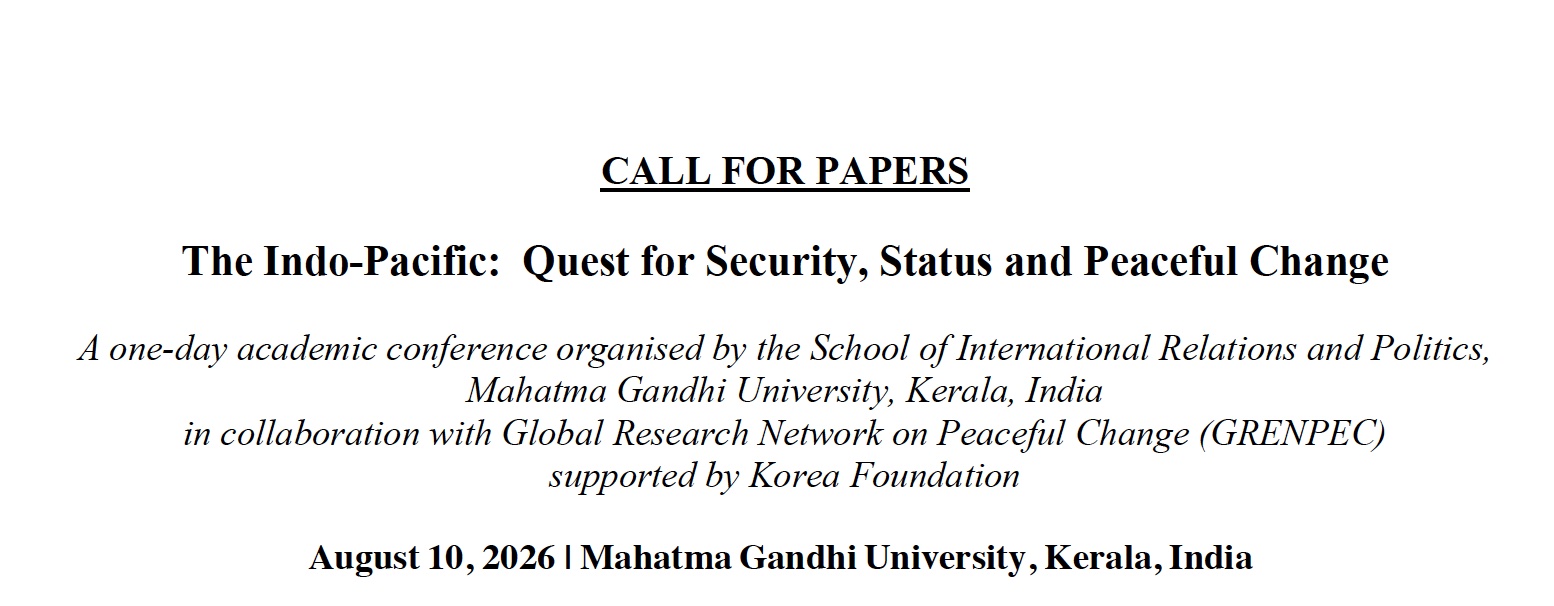
Over the last two decades, the regional imagination of the Indo-Pacific has emerged to overtake Asia- Pacific regional construct, though not without contestation. The Indo-Pacific discourse represents more than shifts in regional countries’ strategic outlooks or expanded geographic scope and membership—it raises fundamental questions about how change occurs in the regional order and whether such transitions will be peaceful or violent. Mainstream discussions of regional order transformation have focused predominantly on great power dynamics, leaving the role of secondary states underexamined. However, while great power dynamics remain central to Indo-Pacific order transformation, the pivotal role of secondary states in initiating, expanding, and sustaining the Indo- Pacific regional imagination cannot be overlooked. This workshop aims to understand Indo-Pacific regional order transformation from the perspective of pivotal powers—a category of secondary states (often interchangeably categorized as rising, middle, or regional powers) with significant capacity and ambition to shape regional order transformation yet frequently overlooked in academic discussions of regional order transition, which remain dominated by great power perspectives.
The workshop proposes to position the research agenda to advance the pivotal power perspective on Indo-Pacific order at the intersection of three major transformations underway in the region. First, the region is undergoing a transition from the post-Cold War regional order featuring liberal internationalism underpinned by US unipolarity to a more complex and contested architecture. The intensification of revisionist tendencies in US foreign policy under Trump 2.0 has not only accentuated the waning of liberal international order but also heightened uncertainty about future regional order architecture. This emerging order features elements of bipolarity (US-China strategic competition), multipolarity (rising influence of multiple powers), yet has space for regional, middle and small power agency—a complex and multilayered regional order which Amitav Acharya conceptualizes as a ‘multiplex’. Second, the regional order transition also been accompanied by growing agency of pivotal powers—India, Japan, Australia, Indonesia, South Korea, and others— who actively shape rather than merely reactive to systemic change. These states increasingly pursue strategic autonomy and refusing binary alignment choices while leveraging multi/minilateral coalitions, economic partnerships, and normative entrepreneurship to advance their regional order visions. Third, the nature of transformation accompanying this order change is characterized by the intensification of regional strategic competition and rivalry alongside increasing calls for stability and peaceful change especially among regional, middle and small powers. Regional security competition extends beyond US-China great power politics to encompass China’s rivalries with multiple regional powers—Japan, India, Vietnam, and others. Crucially, this escalation transcends the military domain, manifesting a comprehensive securitisation across economic, technological, resource control, maritime, supply chain, and critical infrastructure dimensions.
The workshop seeks to advance both theoretical and empirical understanding of pivotal powers’ role in Indo-Pacific order transformation, seeking academic contributions that examine how pivotal powers are adjusting their regional order visions, approaches, and alignments while navigating fundamental dilemmas of how to pursue security, prosperity, and status recognition while August 10, 2026 | Mahatma Gandhi University, Kerala, India simultaneously preserving regional stability and promoting peaceful change. This analytical framework moves beyond great power determinism to foreground the strategies, choices, and normative contestations through which pivotal powers mediate between systemic pressures and regional order outcomes. In this regard we invite proposals submissions addressing (but not limited) the following theme.
Proposals for conference presentations should include a title, an abstract (maximum 250 words) and a short biographical note (maximum 150 words). Selected presentations will be considered for publication in a special issue to be submitted to a peer-reviewed International Relations scholarly journal. Please submit proposals to: cipsmgu@gmail.com. Proposal Submission deadline: February 15, 2026. For inquiries, please contact: Dr. Jojin V John, Assistant Professor, School of International Relations and Politics, Mahatma Gandhi University, Kerala, India. Email: johnjojin@mgu.ac.in

© 2026 Priyadarsini Hills, Kottayam,Kerala,India, Pin: 686560